Hey there! If you’re a building manager, contractor, or even a DIY homeowner thinking about sprucing up stair safety, you’ve probably stumbled across rubber safety edges and gone, “Wait—can I actually use these on stair edges?” As someone who’s been in the rubber safety edge game for years, I get it—stair safety’s not trivial, and you don’t wanna waste cash on something that doesn’t fit the bill. Let’s break this down like we’re chatting over a coffee, no stuffy jargon, just real talk. Rubber Safety Edge

First off, let’s cut to the chase: Yes, rubber safety edge can absolutely be used on stair edges. But let’s not just say “yes” and call it a day—there’s way more to why this works, and when it’s a total home run vs. when you might need to tweak things. Let’s start with why stair edges even need a “safety edge” in the first place. Stair edges (the nosing, right? That overhang part of the step) are where slips, trips, and falls happen more than anywhere else on a staircase. Think about it: when you’re walking up or down, your foot lands right on that sharp, hard edge—if you misjudge, or if your shoes are slippery, that’s a recipe for a tumble. Hard surfaces like concrete or wood don’t give at all; if you bang your knee on a concrete nosing, that’s gonna leave a mark (or worse). Rubber, though? That’s a game-changer for cushioning.
Wait, let’s get specific about rubber safety edge stuff—we’re not talking about random rubber strips here. The good stuff (like what we supply) is made from durable, slip-resistant rubber that’s designed to hold up to foot traffic, moisture, and even heavy use. Stair edges have two main problems rubber solves: impact resistance and slip resistance. Let’s dive into impact first. Studies (yeah, I’ve looked these up for our own product specs) show that padded edges reduce the risk of injury from falls on stairs by a huge margin. A 2021 study from the National Safety Council noted that soft, yielding surfaces on stair nosings cut the severity of impact injuries by 60% compared to hard, unprotected edges. That’s not a random number—when someone trips and their knee hits a rubber-covered edge, it’s just not the same as hitting wood. The rubber absorbs the force, so no broken skin, no bruise that lingers for weeks. That’s a big deal for places like schools, apartment buildings, or even homes with kids or older folks.
Then there’s slip resistance. Stair edges are slick when they’re wet—rain, spilled soda, even a mop that didn’t dry properly. Rubber safety edge is usually formulated with a textured, non-slip surface that adds traction your regular step surface might be missing. I’ve seen way too many stair accidents where someone’s foot slid off the nosing because it was too smooth; rubber adds just enough grip to keep your foot planted. That’s why it’s super popular for outdoor stairs too—back porches, warehouse loading docks, fire escapes—places where moisture is a constant.
But wait, let’s not pretend it’s a one-size-fits-all. You can’t just glue any old rubber strip to your stair edge and call it good. Let’s talk about the types of rubber safety edges that work best for stairs, because there are a few out there. First, there’s extruded rubber stair nosing—this is the kind that’s shaped specifically to fit over the edge of a step, with a flat base that adheres to the step’s tread and a curved, padded lip on the nosing. That’s the one we recommend for most indoor and outdoor applications. Then there’s adhesive-backed rubber edge trim, which works if you’re doing a quick fix on a small set of stairs—though you’ve got to make sure the adhesive is strong enough for high traffic.
Another thing: installation matters. If you want rubber safety edge to actually work, you can’t skip prepping the surface. The stair edge has to be clean, dry, and free of any old paint, glue, or debris. If you’re using adhesive, make sure it’s compatible with both the rubber and the material your stairs are made of (wood, concrete, metal—all have different needs). For outdoor stairs, you’ll wanna use a rubber edge that’s UV-stabilized, so it doesn’t crack or fade in sunlight. Cheaper rubber edges can break down after a year or two outside, so investing in quality (again, what we supply) saves you from redoing the job in 12 months.
I get it, some people might be skeptical—“Rubber on stairs? Won’t it make the stairs look weird?” Let’s address that. Modern rubber safety edges come in all sorts of colors: black, gray, even bright hues like yellow or red. Bright colors are great for commercial spaces where you want the edge to stand out (super important for visually impaired folks, too—they can see the stair edge way easier if it’s a contrasting color). If you want it to blend in, neutral tones work just fine. We even do custom cuts to match your stair size, so it doesn’t look like an afterthought.
What about durability? We’ve had customers tell us our rubber edges have lasted 5+ years in high-traffic areas like school hallways or apartment building stairwells. That’s because the rubber is resistant to scuffs, stains, and even chemicals (if you spill something on it, a quick wipe with a cloth is all it takes). It’s way more low-maintenance than wood or metal trim, which can chip, rust, or splinter over time. For anyone who’s tired of replacing broken stair edges every couple years, rubber is a no-brainer.
Wait, let’s talk about the people who benefit most from this. Parents with young kids: toddlers love to run up and down stairs, and a rubber edge means no more ouchies when they stumble. Property managers: it helps with liability—if there’s a fall, having properly installed safety edges shows you took steps to prevent injury. Older adults or people with mobility issues: the slip resistance and padding take a lot of the stress off when navigating stairs, which is a huge win for accessibility.
I’ve seen some common mistakes people make when using rubber safety edge on stairs, so let’s avoid those. First, not measuring right—if the edge is too short, it doesn’t cover the full nosing, which is where the danger is. Always measure the length of your stair edge twice before ordering. Second, using interior rubber for outdoor stairs—interior rubber isn’t UV-resistant, so it’ll crack and turn brittle in the sun. Third, skipping the installation prep—if the surface is dirty, the adhesive won’t stick, and the edge will peel off after a few months. I always tell customers: take 10 extra minutes to clean the stair edge before installing, it’ll save you a lot of hassle.
Another question I get a lot: Can rubber safety edge be used on curved stairs? Yep, but you need a flexible rubber edge—extruded flexible trim that bends to fit the curve. Rigid edges won’t work for curved stairs, but flexible ones are perfect. We’ve supplied curved edges to office buildings with spiral staircases, and they’ve held up great.
So, putting it all together: Rubber safety edge isn’t just a “nice to have” for stairs—it’s a practical, cost-effective way to make stairs safer. It fixes the two biggest issues with stair edges: impact injuries and slips. As long as you pick the right type (UV-stabilized for outdoor, textured for grip), install it properly, and measure right, it’ll work for almost any staircase—indoor or outdoor, straight or curved, residential or commercial.
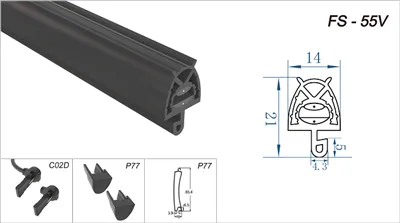
If you’re thinking about adding rubber safety edge to your stairs, don’t overcomplicate it. We’ve worked with tons of folks to figure out exactly what size and type they need, and we’re here to help you pick the right product for your space. No pushy sales stuff, just real advice from someone who’s been in this biz long enough to know what works. If you’re ready to chat about your project, reach out to us to discuss your needs—we can hook you up with samples or help you figure out how much you need.
Rubber Safety Edge References
- National Safety Council. (2021). Stair Safety: Reducing Fall Risks in Residential and Commercial Spaces.
- ASTM International. (2019). Standard Specification for Non-Slip Rubber Edges for Stair Nosings.
- Centers for Disease Control and Prevention. (2020). Injury Prevention: Stair Safety for Older Adults.
- Rubber Manufacturers Association. (2022). Durability and Performance of Extruded Rubber Products for Construction Applications.
Ningbo Futai Safety Edge Technology Co., Ltd.
Ningbo Futai Safety Edge Technology Co., Ltd. is one of the most professional rubber safety edge manufacturers and suppliers in China, also supports customized service. Please feel free to buy advanced rubber safety edge in stock here from our factory. Contact us for free sample and discount information.
Address: No. 1116, Beihuan West Road, Jiangbei District, Ningbo City, Zhejiang Province
E-mail: info@safety-edge.com
WebSite: https://www.safety-edge.com/
