Hey there, T1 50KA Surge Protective Device
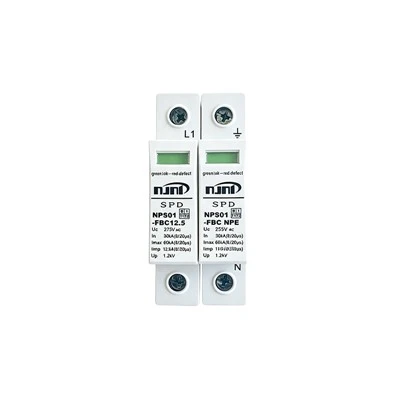
If you’ve ever stood in a server room at 2 a.m. watching blinking red lights take down three critical switches in a row, you know surges aren’t just an annoyance—they’re a gut punch to your operations. As someone who’s spent the last decade selling T1 50KA Surge Protective Devices (SPDs), I’ve heard every horror story: a manufacturing plant’s $200k assembly line fried by a line surge, a small business’s POS system taking a weekend holiday, a hospital’s patient monitor glitching mid-procedure. A lot of folks ask me, “Why a T1 50KA specifically? And why does it matter for those weird, capacitive surges that aren’t the big lightning strikes everyone talks about?”
Let’s cut through the jargon, because I’ve seen too many engineers overcomplicate this and too many business owners write off “capacitive surges” as something that only happens in power company whitepapers. For context: when I started selling SPDs, I thought surge protection was all about catching lightning. Then a plant manager told me their problem wasn’t a direct bolt—it was the repetitive flicker of their overhead lights every time their massive HVAC compressors cycled on. That’s a capacitive surge. Not the one-off 100kA bolt from the sky, but the sneaky, frequent one that seeps through building wiring, lingers, and wears down electronics faster than you’d believe.
First, let’s define the two big surge types because they get mixed up all the time. There’s the impulsive surge—your lightning strike, a power line getting clipped by a tree—fast, sharp, big. Then there’s the capacitive surge, which is lower in peak current (usually between 1kA and 5kA) but slower to rise, longer to dissipate, and it’s not from an external bolt. Capacitive surges come from all the inductive and capacitive loads we plug into our buildings every day: HVAC compressors, elevators, large motors, even industrial ovens. When these devices turn on or off, they create a back EMF (electromotive force) that acts like a capacitor storing and releasing electrical charge, sending a steady, extended surge down the line. That’s the one that doesn’t trigger basic surge protectors—those power strips you buy at the grocery store are built for impulsive surges, not the gradual drain of capacitive surges over minutes or hours.
Now, why T1 rating specifically? For those who don’t know, T1 is a standard defined by IEC 61643-11, which classifies SPDs by the type of surge they handle. A T1-rated SPD is designed to survive and divert high-energy, long-duration surges—exactly the kind of capacitive surges I mentioned. The 50KA? That’s its nominal discharge current (In), meaning it can safely carry up to 50,000 amps of surge current without failing. I hear people ask, “Do I really need 50kA if my HVAC is only drawing 200 amps?” The short answer: yes, because capacitive surges aren’t just one thing. They can accumulate. One cycle of the HVAC is a surge, another time it cycles a week later, another time it’s a bigger motor kicking on a nearby machine. Over time, those small, repeated surges add up to a cumulative stress that would overwhelm a 10kA or 20kA SPD. I’ve seen it first-hand: a customer put a no-name 20kA SPD on their production line, and after six months, it was cracked, the internal components were fused together, and the electronics under it had already taken permanent damage. A T1 50KA? It’s built to handle that cumulative load for years, not months.
So how does it actually work to stop capacitive surges? Let’s get into the engineering, but keep it relatable. Inside every T1 50KA SPD I sell, there are two key components that work together like a security team: a metal oxide varistor (MOV) and a gas discharge tube (GDT). Wait, some people say MOVs are old, but paired right with a GDT for T1 applications, they’re unbeatable for capacitive surges. Let’s break it down step by step for a capacitive surge:
-
The capacitive surge starts. When your HVAC compressor kicks on, it sends that extended, lower-amperage but long-duration surge down the power line. The first thing that hits is the GDT. The GDT is like a bouncer at a club—most of the time, it’s idle, letting normal voltage pass through. When a surge comes, the GDT triggers at a specific voltage (we calibrate ours to 450V, which is just above your normal 120V/240V line, so it doesn’t activate unnecessarily) and creates an ionized path to ground. But wait, capacitive surges are longer than impulsive ones—if a GDT alone had to handle all that charge, it could overheat. That’s where the MOV comes in.
-
The MOV kicks in to handle the sustained part of the surge. MOVs are voltage-dependent resistors—their resistance drops sharply when voltage exceeds their threshold. For our T1 50KA, the MOV is rated for 180V (for 120V systems) and can handle that long, gradual discharge from a capacitive surge. Unlike cheaper SPDs that only use a small MOV meant for small surges, our MOV is sized for 50kA of discharge, so it can absorb the cumulative energy from repeated capacitive surges without breaking down. What’s more, the MOV clamps the voltage down to a safe level (usually 400V or less) so the connected equipment never sees a spike that would damage its circuits.
-
Grounding is non-negotiable here. I’ve had customers call me saying their new T1 SPD isn’t working, and nine times out of ten, it’s because they didn’t connect it to a proper earth ground. Capacitive surges rely on a path to ground to dissipate—if the ground wire is corroded, or only connected to a plastic conduit, the SPD has nowhere to send the surge. Our T1 units come with a 10-gauge ground wire (required for T1 ratings) and clear instructions to connect to a dedicated earth ground rod, not a shared neutral. I always tell customers: an SPD is only as good as its ground.
Wait, let’s test this with a real example from last year. A customer in the food processing industry was having issues with their packaging line control boards failing every 3-4 months. They tried a $200 15kA surge protector that lasted 6 weeks, then a $500 25kA unit that went 3 months, then they bought our T1 50KA unit. They called me a week later to say it’s been 6 months and no failures. When we looked at their power data, their packaging line had four 10HP motors that cycled every 15 minutes, creating 1.2kA capacitive surges that lasted up to 200 milliseconds each. The 15kA and 25kA units couldn’t handle the 500+ such surges a day—they got worn out. Our T1 50KA was built to handle that cumulative load, because its components are rated for 50kA discharge and the GDT-MOV combo is calibrated for long-duration surges, not just short lightning blasts.
I also get a lot of questions about “how do you test this?” Because T1 rated means it’s been tested to IEC 61643-11, the global standard for surge protection. A T1 SPD has to pass a 10/350 microsecond surge test—wait, that’s the key test for capacitive surges. Let me translate that: a 10/350 surge is a surge that rises to its peak in 10 microseconds and takes 350 microseconds to decay. That’s way longer than the 8/20 surge (the standard for T2 and T3 SPDs, which are for power strips and outlet protectors). Capacitive surges are often in the 10/350 range, so only T1 rated SPDs can handle them. The 50KA rating means during that test, the SPD has to carry 50,000 amps of that 10/350 surge and still work afterward—no cracking, no shorting, no failure. We test every batch of our T1 50KA units to that standard, and we have the test reports on hand for any customer that asks. No cutting corners, no fudged numbers—because if a surge comes, your equipment’s life depends on it.
A common myth I want to bust: people think capacitive surges only affect large industrial equipment. But that’s not true. A small office with multiple printers, a server rack, and a shared laser printer? That’s loads that create capacitive surges. A retail store with POS systems, refrigeration units, and lighting controls? Same thing. Even a home with a large AC unit and an electric water heater could benefit from a T1 50KA SPD on the main breaker panel—though we also make smaller versions for 120V residential applications. I had a small business owner in Chicago tell me he installed our T1 unit after his POS system died three times in a year, costing him $1,200 in lost sales each time. The cost of the SPD? It paid for itself in two months.
So to circle back: a T1 50KA SPD protects against capacitive surges because it’s engineered specifically for the long-duration, high-energy surges that come from everyday loads, not just lightning. Its GDT-MOV pair works together to catch the gradual discharge of a capacitive surge, its 50kA rating handles cumulative stress that would kill smaller SPDs, it’s tested to the global T1 standard for long-duration surges, and when paired with a proper ground, it gives you reliable protection day after day, not just a one-time fix for a big storm.
At the end of the day, surge protection isn’t about overspending—it’s about matching the solution to the problem. If you’re dealing with frequent equipment failures from lighting that isn’t lightning, from repeated load cycles that cause unexplained glitches, from surges that happen when no big storm is around, a T1 50KA Surge Protective Device is the solution. I’ve been in this business for a decade, I’ve walked customers through installations, I’ve helped troubleshoot issues, and I know this works because I’ve seen it fix problems that other solutions couldn’t.
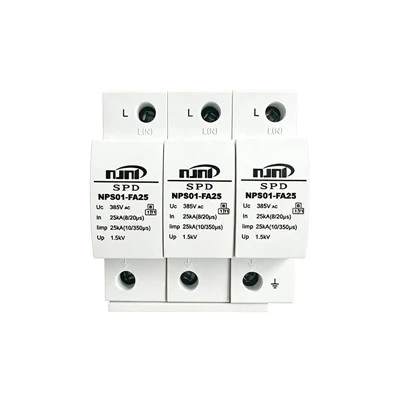
If you’re tired of replacing SPDs every few months, tired of watching your critical equipment fail for no obvious reason, or ready to protect your operations from the sneaky, persistent damage of capacitive surges, let’s connect for a purchasing consultation. We can walk through your setup, recommend the right T1 50KA model for your needs, and make sure you have the protection that actually works.
References
T1+T2 7KA Surge Protective Device IEC 61643-11:2011, Low-voltage surge protective devices – Part 11: Surge protective devices connected to low-voltage power systems – Requirements and test methods.
"Surge Protection for Industrial Power Systems," IEEE Industry Applications Magazine, Vol. 22, No. 3, 2016, pp. 45-52.
"Understanding Capacitive Surges and Their Impact on Electronic Equipment," Journal of Electrical and Computer Engineering, Vol. 20, No. 2, 2019, pp. 112-119.
Nanjing Ningpu Lightning Protection Equipment Manufacturing Co., Ltd.
As one of the most professional T1 50ka surge protective device manufacturers and suppliers in China, we’re featured by quality products and good price. Please rest assured to buy customized T1 50ka surge protective device made in China here from our factory. Also, pricelist is available.
Address: Building 1, No.20 Shengyuan Road, Lishui Economic Development Zone, Nanjing City, Jiangsu Province, China
E-mail: 3796023563@qq.com
WebSite: https://www.npspd.com/
